
What Is an Offshore Company and What Is It For?
What an offshore company is, what it is for, costs, benefits and myths
Cristina Teixeira · Aug 25, 2026

An offshore company, or Personal Investment Companies (PICs), as we mentioned in the previous post, published on 06.16.2025, is a company established in a foreign country for the purpose of managing assets and making investments. The term “offshore” refers to the entity’s location, which lies “off the coast” of its country of origin — that is, basically any company incorporated outside that jurisdiction. In the case of the US, any company outside American territory is considered an offshore company; in other words, for US purposes a Brazilian limited liability company is also considered an offshore company.
Offshore companies are often incorporated in jurisdictions that offer tax and regulatory advantages, also known as “tax havens”.
And what is a “tax haven”?
The term “tax haven” is frequently associated with offshore companies. But it is worth stressing that not every offshore company is based in a tax haven. A tax haven is a jurisdiction that offers tax and regulatory advantages, making it attractive to individuals and companies that wish to optimize their tax burden and protect their assets.
These are places where taxes are very low, or do not even exist, and only a fixed annual fee is charged to the offshore holder to maintain the structure. In Brazil, the Federal Revenue Service classifies countries that levy less than 20% in taxes as: “countries or dependencies with favorable taxation and privileged tax regimes”.
And is it legal to have an offshore company?
Offshore companies* are completely legal when used in compliance with the laws of the owners’ country of origin and of the jurisdictions where they are registered. Brazilian tax authorities require all Brazilian tax residents to report their assets globally, as well as their income. The same applies to investors who hold an offshore structure. Many countries have regulations in place to ensure that offshore companies are used for legitimate purposes, such as tax planning and asset management.
What Are the Benefits of Having an Offshore Company
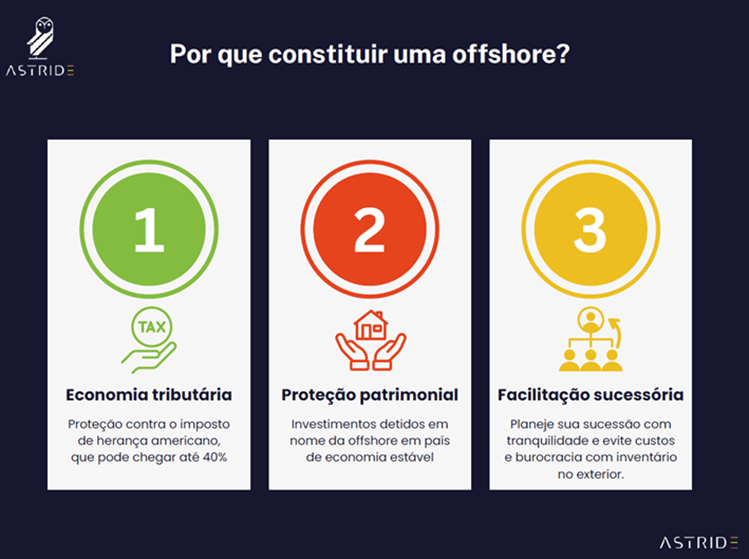
- Asset Protection: By holding your investments through an offshore company, you gain a legal barrier, since your assets are held in the company’s name rather than in your own; you invest in other countries, diversifying your risk and gaining access to more stable economies and a strong currency; and finally, you benefit from the confidentiality of another jurisdiction.
- Simplified Succession: With an offshore company, you avoid US estate tax and there is no need to open probate in the US, provided it is implemented together with some succession instrument. As a result, the succession process takes only 1 to 3 days to be completed.
- Tax Efficiency: protection against US estate tax, as well as the possibility of a tax election, which we will address in greater detail in the post of 09/25/2024.
How Much Does It Cost and How Do You Open an Offshore Company?
The costs of opening and maintaining an offshore company vary widely depending on the jurisdiction chosen, the complexity of the structure and the services required. The costs include registration fees, legal and accounting fees, as well as ongoing compliance expenses. For more information, get in touch with the Astride team or call: + 1 (786) 300-5382
How long does it take to open an offshore company?
Opening an offshore company in the BVI (British Virgin Islands) through Astride, for example, takes around 1 to 3 days after all partners and directors complete their registration on the platform.
How Do You Send Money to an Offshore Company?
Once your offshore company has been created, you can send funds through international wire transfers. It is crucial to comply with all tax and regulatory obligations both in the country of origin and in the offshore jurisdiction.
Main Myths and Truths About Offshore Companies:
- Myth: An offshore company is illegal | Truth: Offshore companies are legally regulated in many jurisdictions, including Brazil.
- Myth: Gains from an offshore company can be used without paying taxes | Truth: Offshore gains are generally subject to taxation, in accordance with the laws of your country of residence.
- Myth: An offshore company is expensive to open and maintain | Truth: Although there are costs involved, they vary widely and can be justified by tax advantages and asset protection.
- Myth: An offshore company is complicated and hard to deal with | Truth: Setting up an offshore company may seem complex, but with the right support it is feasible for many investors.
- Myth: An offshore company is only useful for large investors | Truth: Offshore companies offer benefits beyond substantial investments, such as asset protection and succession planning.
- Myth: Offshore companies are mainly used for tax evasion | Truth: Although there are cases of abuse, most offshore companies are created for legitimate wealth, financial and tax management purposes.
Other Truths:
- Offshore companies are legally regulated: Offshore companies are recognized by many countries and are subject to legal and tax regulations.
- Asset protection: One of the main advantages is protecting assets from risks and litigation in the country of origin.
- It facilitates succession: Offshore companies simplify the transfer of assets to heirs, minimizing legal complications.
- Minimization of estate tax: Offshore companies can help reduce exposure to estate tax, but they require strategic planning.
- Legitimate tax benefits: Offshore companies allow losses and expenses to be deducted in accordance with the applicable tax laws.
*Considering the aspects shared in this post, we at Astride believe that an offshore structure becomes accessible to investors who wish to invest amounts starting at US$200,000 or who intend, in the medium term, to reach and/or exceed that figure. Offshore companies can be advantageous for a broader audience, and, with the prices we offer through an automated service, this structure is no longer accessible only to multimillionaire investors or holders of large fortunes.